GROUP STAGE RESEARCH & ANALYSIS
Design for Displacement
MArch 5th Year Architecture Studio
Studio Tutor: Laurence Wood
2025-2026
University of Dundee
Eilidh Bauchop
Lewis Duncan
Daniel Ellington
Miruna Georgescu
Tara Hart
Bota Issatayeva
Hussein Khalil
Abdu Mahdi
Tom Robertson
Bridget Schneider
Ryan Smith
Luca Sode
Josie Strachan
ARCHITECTURE
CAN PREPARE.
DESIGN 4
DISPLACEMENT


of DISPLACEMENT · of PREPAREDNESS · of GOVERNANCE · of EDUCATION · of LAND MANAGEMENT · of JUSTICE · of COMMUNITY BUILDING · of INDUSTRY ·
LOOK LIKE?
WHAT DOES THE FUTURE
This is our studio's guiding question, informed by personal interest and unit aims.
Our aim is to investigate systems which can dissolve the impact of inevitable disasters in the future. Disasters can occur at all scales, from inequitable healthcare systems to raging wildfires.
We have adopted the approach that "there are no natural disasters" from the UN to assert that regardless of the cause, life-threatening disasters are the consequences of our lack of preparedness and recognition of vulnerabilities.
UNIT AIMS
ARTIFICIAL INTELLIGENCE
To understand how AI is altering the foundational systems of society.
1
To critically examine the implications of centralized and decentralized models.
DISTRIBUTION MODELS
2
To develop speculative and actionable architectural responses for vulnerable populations.
ARCHITECTURAL RESPONSES
3
To work across architectural, technological, and social scales.
WORK ACROSS SCALES
4
WHAT IS
DESIGN FOR DISPLACEMENT?
Architecture’s involvement with displacement is most commonly associated with post-disaster images of war or extreme weather events, where people are forced to flee their homes and livelihoods. In response, we design emergency shelters and infrastructure as a form of humanitarian aid.
But what if we look at it from a broader perspective? A wide range of factors contribute to displacement around the world. By seeing these factors as outcomes of a complex network of interconnected systems, we can investigate the role architects might play in addressing the forces that lead to displacement.
This unit explores several of these systems including healthcare, infrastructure, climate, and education, across various scales. A strong strategy within one system can help prevent displacement, but a cohesive strategy across multiple systems is more resilient and sustainable.
The core position of our unit is that proactive strategies, based on thorough analysis of current systems are the best way to address current and potential future vulnerabilities. This informs our architectural approach, shaping how and what we build.

Fig. H.01; A Proactive Strategy vs a Reactive Strategy
"Every £1 invested in proactive healthcare measures in Scotland, is the equivalent of £32 being spent
reacting to the problem."
- Tim Zijlstra, NHS Tayside, 2025

Fig H.02; Design for Displacement 1
Minh Le Uyen Tran
Gilian Charisse Fronda
Beatrice Kalyani Ryan
Andrea Nicole Casono
2022 - 2023

Fig H.03; Design for Displacement 2
Jakub Duda
2023 - 2024
PAST STUDIOS
In the past this studio unit has explored a wide variety of approaches to pre and post disaster design, from rebuilding cities, modernising systems, and preparedness strategies. Their work has focused on key disaster-prone regions like the Middle East and South-East Asia.
MOVING FROM BRIEF TO MACRO
ANALYSIS
This year we decided to shift our focus towards non-traditional displacement conditions to demonstrate that forced movements can occur in all contexts and scales, whether it involves five people on a remote Hebridean island moving to the mainland to access healthcare or a large wildfire destroying the homes of an entire Portuguese community.
We also sought to investigate how methods of dealing with displacement can be integrated into existing and potential future systems. We approached this by starting with our four unit aims. For each, we explored relevant macro-level (global) issues, including economics, governance, climate, and displacement. At the meso level, we examined how these issues affect specific countries, while the micro level shows how they crystallise into local conditions which can later be addressed through an architectural strategy.
UNIT AIMS
1.
To develop speculative and actionable architectural responses for vulnerable populations.
To work across architectural, technological and social scales.
To critically examine the implications of centralised and decentralised models.
To understand how AI is altering the foundational systems of society.
2.
3.
4.
OUR PROMETHEAN MOMENT
This year, our studio agenda isn’t defined by a singular geographical context or disaster, such as a typhoon, earthquake, or war.
At all levels, society is navigating through a “Promethean Moment”, a period marked by transformative technologies or ideas that fundamentally reshape how we interact with the world. The term references the story of Prometheus from Greek Mythology, who stole fire from the gods to give to humans, an act that altered the course of human history.
Other promethean moments in history include the invention of the wheel, the printing press, the industrial age and most recently our current moment, defined by the rapid development and widespread use of AI.
IMPACT ON ARCHITECTURE
This will inevitably affect systems and architectural space, just as the assembly line influenced Le Corbusier's Domino House, whose DNA exists in almost every multi-storey building in the world that was built since.
This unit will explore how AI reshapes core infrastructure, social life, & economies, and investigates the spatial implications of systems that integrate or resist technological change, framed through preparedness strategies.
This work is developed alongside a wider context of climate change and increasing worldwide social and political instability.
Fig. H.04; Promethean Moments Timeline


Fig. H.05; Northern and Southern Europe
MESO SITE LOCATIONS
To explore these aspects, we selected Scotland and Portugal as case studies, representing similarly developed northern and southern European countries. This allows us to examine two contrasting regions that face their own distinct challenges, while applying one shared core methodology.
OUR GUIDING
QUESTION
GOVERNANCE
HEALTHCARE
WHAT DOES THE FUTURE OF LAND MANAGEMENT LOOK LIKE?
COMMUNITY
EDUCATION
CLIMATE PREPAREDNESS
This is our studio's guiding question, informed by personal interest and unit aims.
Our aim is to investigate systems which can dissolve the impact of inevitable disasters in the future. Disasters can occur at all scales from inequitable healthcare to wildfires. We have adopded the approach that 'there are no natural disasters', from the UN to assert that regardless of cause, disasters are the consequences of our lack of preparedness and recognition of vulnerabilities.
Master Diagram
This 6-page master diagram illustrates our group stage process as we moved between scales of research & analysis
Click on a page to view larger


STUDIO UNIT INTRODUCTORY
VIDEO
This video introduces the broader context of current global issues and how it has framed the outlook of this year's Design for Displacement studio.


For our unit’s presentation, we chose to move away from a traditional pin-up and design booklet format, instead showcasing our work through an interactive website and video. This was done to communicate a complicated set of information in a user-friendly way.
Current trends show that the average attention span is decreasing. (Jade Padam, Camargue, 2025). Therefore our challenge is to present a complex body of research & analysis in an accessible way- hence, our "fishbowl metaphor" for our website.
This website is a fishbowl, with different topics such as Climate, AI or Displacement are imagined as small fish swimming within it. The fishbowl doesn't lead a reader down a linear or chronological structure, like an essay or printed booklet. Our website instead encourages viewers to reach into the "bowl" and select which "fish," or topic, they want to look at in detail.
This reflects the nature of our research, where these themes coexist, intersect, and influence one another in complex and non-linear ways. This website’s design allows for immersive, self-directed navigation, enabling each viewer to curate their own path through our work.
WHY A WEBSITE?
Fig. H.06; "The Goldfish Bowl"
CLICK A SCALE OF RESEARCH TO LEARN MORE


MACRO
Fig. H.07; The World
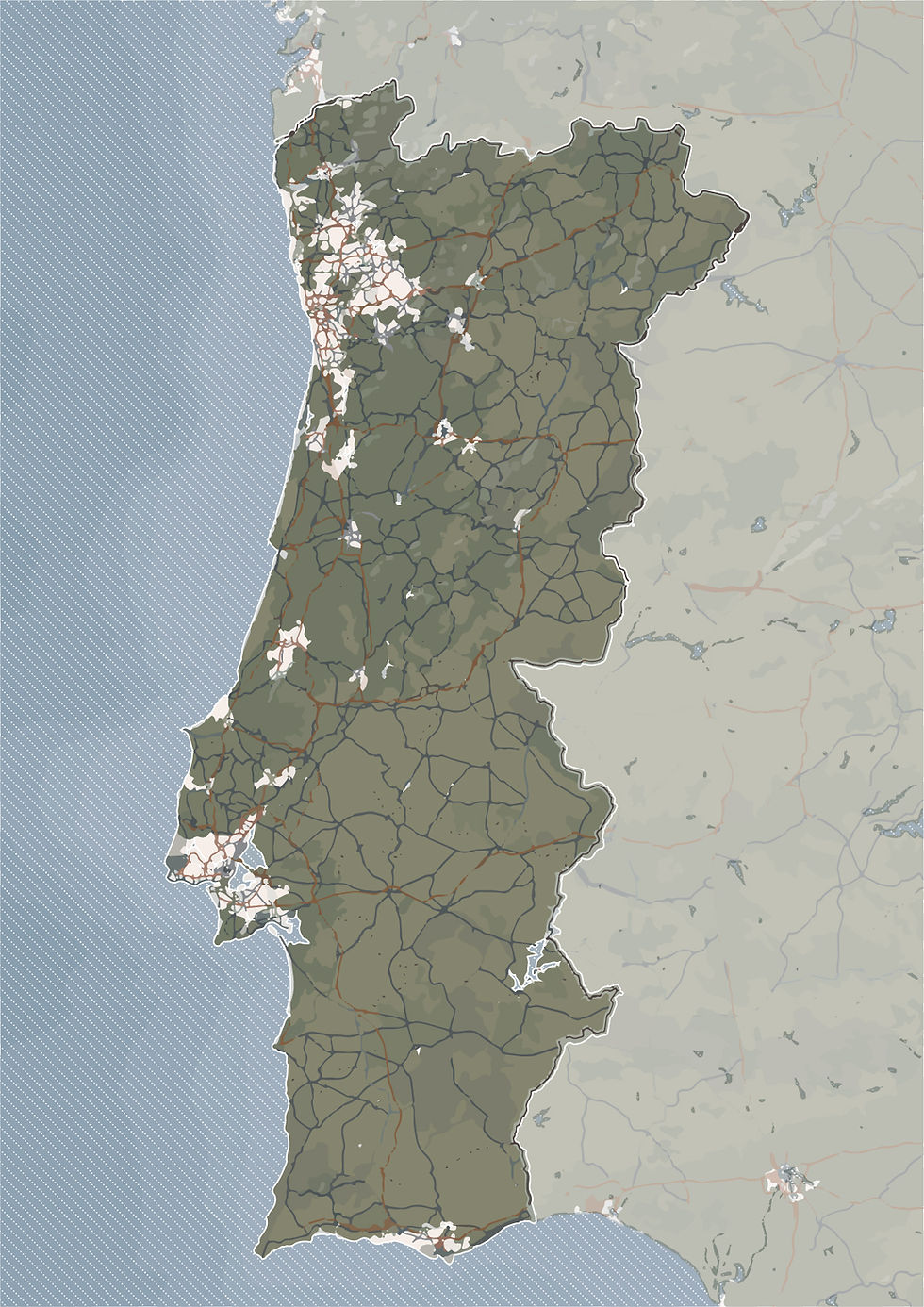
MESO Portugal
Fig. H.08; Portugal
MESO Scotland
Fig. H.09; Scotland
GROUP STAGE RESEARCH & ANALYSIS
Design for Displacement
MArch 5th Year Architecture Studio
Studio Tutor: Laurence Wood
2025-2026
University of Dundee
Hussein Khalil
Abdu Mahdi
Tom Robertson
Bridget Schneider
Ryan Smith
Luca Sode
Josie Strachan
Eilidh Bauchop
Lewis Duncan
Daniel Ellington
Miruna Georgescu
Bota Issatayeva